

Capstone: your physics, end to end#
A ball thrown with air drag that ramps on past a critical speed, built from pieces the last three tutorials already taught, now put to work together.
Time: ~10 min · Runs on: CPU (GPU: a card picks it up automatically) · You need: stop when you’re done, a family of kernels, extend it by inheritance, your own derivative
import math

import numpy as np
import torch

print("DEVICE:", DEVICE, "| torch:", torch_device)
DEVICE: cpu | torch: cpu
Two kernel shapes for the same physics#
Perturbed below is a FRESH Kind hierarchy built for this page, not a
reuse of a family of kernels’s Orbit: that
one declared r/v as plain inputs, but flight_sim here needs them
Mutable (it writes the next state back into them for eagle.simulate
to carry forward), while flight_step needs them as plain inputs (old
state in) with separate r_next/v_next outputs. Same idea — one
Kind, more than one model — a different concrete vocabulary for a
different job, plus terminated, which neither earlier model needed.
import hawk
from hawk import Mutable, Param, Scalar, Terminated, Vector
from hawk.ext import KernelKind, primitive
from hawk.math import exp, log, norm, vec


class Orbit(KernelKind, slug="orbit_capstone"):
    terminated: Terminated
    dt: Param
    g: Param


class Perturbed(Orbit, slug="perturbed_capstone"):
    cd: Scalar
speed_ramp is the same custom primitive as
last tutorial, declared fresh for this page’s own kernels:
@primitive("capstone_speed_ramp",
           vjp=lambda s, bar: bar / (1.0 + exp(-s)),
           jvp=lambda s, ds: ds / (1.0 + exp(-s)))
def speed_ramp(s):
    return log(1.0 + exp(s))
flight_sim reads its own state before writing it — the value carried
from the previous launch, exactly what eagle.simulate’s repeated
launches need:
@Perturbed
def flight_sim(terminated, dt, g, cd, v_crit: Param,
               r: Mutable[Vector[3]], v: Mutable[Vector[3]]):
    ramp = speed_ramp(norm(v) - v_crit)
    a = vec(0.0, 0.0, -g) - cd * ramp * v
    v = v + dt * a
    r = r + dt * v   # sequential: uses the NEW v (tutorial 03's note)
    terminated = r[2] < 0.0
flight_step is the SAME physics, as a pure function instead: old r,
v in; new r, v out — the shape a derivative, or loss.backward(),
can see the whole of:
@Perturbed
def flight_step(r: Vector[3], v: Vector[3], v_crit: Param, dt, g, cd, terminated,
                 r_next: Mutable[Vector[3]], v_next: Mutable[Vector[3]]):
    ramp = speed_ramp(norm(v) - v_crit)
    a = vec(0.0, 0.0, -g) - cd * ramp * v
    v_next = v + dt * a
    r_next = r + dt * v_next   # sequential: uses NEW v_next (tutorial 03's note)
Run it at scale#
eagle.simulate already knows how to step a kernel until every sample’s
terminated flag is set — stop when you’re done
covered this; here it runs flight_sim over a real batch:
n = batch_size(gpu=1_000_000, cpu=100_000)
rng = np.random.default_rng(0)
speed = 20.0 + 20.0 * rng.uniform(size=n)
elevation = np.radians(20.0) + np.radians(50.0) * rng.uniform(size=n)
heading = 2.0 * np.pi * rng.uniform(size=n)
v0 = np.stack([speed * np.cos(elevation) * np.cos(heading),
               speed * np.cos(elevation) * np.sin(heading),
               speed * np.sin(elevation)])
r0 = np.zeros((3, n)); r0[2] = 1.0
cd0 = np.full(n, 0.004)
eagle.simulate takes the kernel and every plane it reads or writes, by name:
import eagle

result = eagle.simulate(
    flight_sim, r=xp.asarray(r0), v=xp.asarray(v0),
    dt=0.02, g=9.81, cd=xp.asarray(cd0), v_crit=25.0, max_steps=2000)
print(f"{n:,} balls, {result.status}, {result.steps} steps, "
      f"{int(result.finished.sum()):,} landed, {result.wall_s:.3f} s wall")
100,000 balls, finished, 384 steps, 100,000 landed, 0.115 s wall
A derivative needs the pure shape#
flight_sim reads v and r before writing them — the value carried
from the previous launch — and hawk.diff refuses to differentiate
through that on principle: it keeps no tape between launches, so a
derivative through a recurrence it cannot see the whole of would be a
plausible wrong answer, not a crash. flight_step is the per-launch term
the refusal message points to:
from hawk.diff import vjp
from hawk.ir import HawkError

try:
    vjp(flight_sim, wrt=("v",))
except HawkError as exc:
    print("refused:", str(exc)[:120])
refused: 'r' is read before it is assigned: a plane's launch-start value is a recurrence across launches; its derivative needs th
Wrapping the pure kernel for PyTorch#
eagle.frameworks.torch.function wraps flight_step as a
torch.autograd.Function: its backward runs hawk’s derived reverse-mode
kernel, its forward-mode AD the derived forward-mode one.
from eagle.frameworks import torch as eagle_torch

step = eagle_torch.function(flight_step, wrt=("r", "v", "cd"))

nn = 32
gen = torch.Generator().manual_seed(0)
r = torch.randn(3, nn, dtype=torch.float64, generator=gen, device=torch_device,
                requires_grad=True)
v = torch.randn(3, nn, dtype=torch.float64, generator=gen, device=torch_device,
                requires_grad=True) + 5.0
cd = torch.full((nn,), 0.01, dtype=torch.float64, device=torch_device,
                 requires_grad=True)
not_landed = torch.zeros(nn, dtype=torch.bool, device=torch_device)


def call(r, v, cd):
    return step(r=r, v=v, v_crit=25.0, dt=0.02, g=9.81, cd=cd, terminated=not_landed)
torch.autograd.gradcheck is PyTorch’s own standard check: it perturbs
each input by a tiny amount, compares the result to call’s reported
gradient, and raises if they disagree beyond its tolerance — the same
idea as this family’s own finite-difference checks, run by a library
instead of by hand:
ok = torch.autograd.gradcheck(call, (r, v, cd),
                               check_forward_ad=True, check_batched_grad=False)
print("gradcheck (reverse AND forward mode):", ok)
gradcheck (reverse AND forward mode): True
One more check, kept for the dashboard at the end of this page: cd’s
own gradient against a hand-rolled central difference.
r_next, v_next = call(r, v, cd)
((r_next ** 2).sum() + (v_next ** 2).sum()).backward()
ad_grad = cd.grad.clone()

H = 1e-6
with torch.no_grad():
    rp, vp = call(r, v, cd + H)
    rm, vm = call(r, v, cd - H)
    fd_grad = (((rp ** 2).sum(dim=0) + (vp ** 2).sum(dim=0))
               - ((rm ** 2).sum(dim=0) + (vm ** 2).sum(dim=0))) / (2 * H)
print("max |AD - FD| over", nn, "samples:", float((ad_grad - fd_grad).abs().max()))
max |AD - FD| over 32 samples: 1.4806493336916615e-08
Synthetic throws to fit against#
256 balls thrown with a TRUE drag coefficient of 0.004/m, 5 cm of
measurement noise added — the data the rest of this page fits cd
against:
DT, G, VCRIT, STEPS = 0.02, 9.81, 25.0, 60
N, CD_TRUE = 256, 0.004

rng2 = torch.Generator().manual_seed(1)
speed_t = 20.0 + 20.0 * torch.rand(N, dtype=torch.float64, generator=rng2)
elevation_t = (math.radians(20.0) + math.radians(50.0)
               * torch.rand(N, dtype=torch.float64, generator=rng2))
heading_t = 2.0 * math.pi * torch.rand(N, dtype=torch.float64, generator=rng2)
v0_t = torch.stack([speed_t * elevation_t.cos() * heading_t.cos(),
                     speed_t * elevation_t.cos() * heading_t.sin(),
                     speed_t * elevation_t.sin()]).to(torch_device)
r0_t = torch.zeros(3, N, dtype=torch.float64, device=torch_device)
r0_t[2] = 1.0
def thrown_to(cd_value):
    """Roll every ball out to landing at a fixed cd; no grad needed here."""
    cd = cd_value.expand(N).contiguous()
    r, v = r0_t, v0_t
    with torch.no_grad():
        for _ in range(STEPS):
            landed = r[2] < 0.0
            r_next, v_next = step(r=r, v=v, v_crit=VCRIT, dt=DT, g=G, cd=cd,
                                   terminated=landed)
            r, v = torch.where(landed, r, r_next), torch.where(landed, v, v_next)
    return r
Roll out the truth, add sensor noise, and start the fit from a value 4x too high:
truth_final = thrown_to(torch.tensor(CD_TRUE, dtype=torch.float64, device=torch_device))
noise_gen = torch.Generator().manual_seed(2)
observed = truth_final + 0.05 * torch.randn(truth_final.shape, dtype=torch.float64,
                                             generator=noise_gen).to(torch_device)
CD_GUESS = 4.0 * CD_TRUE   # clearly wrong on purpose -- the fit has real work to do
print("true cd:", CD_TRUE, "| starting guess:", CD_GUESS)
true cd: 0.004 | starting guess: 0.016
Fit cd with SGD#
cd, registered as a torch.nn.Parameter and run through flight_step
each step, is an ordinary model: loss.backward() computes its
gradient, and torch.optim.SGD (plain stochastic gradient descent: each
step moves the parameter by -learning_rate * gradient, nothing
fancier) updates it.
class BallisticRaw(torch.nn.Module):
    def __init__(self, cd_guess):
        super().__init__()
        self.cd = torch.nn.Parameter(torch.tensor(cd_guess, dtype=torch.float64))

    def forward(self):
        cd = self.cd.expand(N).contiguous()
        r, v = r0_t, v0_t
        for _ in range(STEPS):
            landed = r[2] < 0.0
            r_next, v_next = step(r=r, v=v, v_crit=VCRIT, dt=DT, g=G, cd=cd,
                                  terminated=landed)
            r, v = torch.where(landed, r, r_next), torch.where(landed, v, v_next)
        return r
One step is already a problem:
raw_model = BallisticRaw(CD_GUESS).to(torch_device)
raw_opt = torch.optim.SGD(raw_model.parameters(), lr=1e-3)
raw_opt.zero_grad()
loss = ((raw_model() - observed) ** 2).mean()
loss.backward()
grad_before = raw_model.cd.grad.item()
raw_opt.step()
print(f"loss = {loss.item():.5f}, d(loss)/d(cd) = {grad_before:.2f}")
msg = f"cd: {CD_GUESS} -> {raw_model.cd.item():.5f} after ONE step"
print(msg, "-- already negative, unphysical")
loss = 0.55714, d(loss)/d(cd) = 77.12
cd: 0.016 -> -0.06112 after ONE step -- already negative, unphysical
The log-reparameterization trick#
cd’s gradient (printed above, around 77) is large relative to cd’s
own tiny scale (0.004-0.016), so an ordinary step overshoots straight
past zero. Optimizing log(cd) instead keeps the step proportional to
the parameter’s own size, and .exp() in forward keeps cd positive
no matter what:
class Ballistic(torch.nn.Module):
    def __init__(self, cd_guess):
        super().__init__()
        self.log_cd = torch.nn.Parameter(
            torch.tensor(math.log(cd_guess), dtype=torch.float64))

    def forward(self, track_path=False):
        cd = self.log_cd.exp().expand(N).contiguous()
        r, v, path = r0_t, v0_t, [r0_t]
        for _ in range(STEPS):
            landed = r[2] < 0.0
            r_next, v_next = step(r=r, v=v, v_crit=VCRIT, dt=DT, g=G, cd=cd,
                                  terminated=landed)
            r, v = torch.where(landed, r, r_next), torch.where(landed, v, v_next)
            if track_path:
                path.append(r)
        return torch.stack(path) if track_path else r
model = Ballistic(CD_GUESS).to(torch_device)
log_opt = torch.optim.SGD(model.parameters(), lr=1e-3)
for epoch in range(5):
    log_opt.zero_grad()
    loss = ((model() - observed) ** 2).mean()
    loss.backward()
    log_opt.step()
    msg = f"epoch {epoch}: loss = {loss.item():.5f}"
    print(msg, f"cd = {model.log_cd.exp().item():.5f}")
epoch 0: loss = 0.55714 cd = 0.01598
epoch 1: loss = 0.55562 cd = 0.01596
epoch 2: loss = 0.55411 cd = 0.01594
epoch 3: loss = 0.55260 cd = 0.01592
epoch 4: loss = 0.55110 cd = 0.01590
Same learning rate that broke cd directly now makes small, stable
progress — real, but slow enough that a sharper optimizer is worth
reaching for.
Switch to L-BFGS#
L-BFGS (limited-memory BFGS: a quasi-Newton optimizer that uses
curvature, not just the gradient, to take much bigger steps than SGD)
may re-evaluate the loss several times per step, so PyTorch asks for a
closure — a zero-argument function it can call again itself, as many
times as its line search needs — instead of one loss.backward(). Same
Ballistic model, starting fresh from the same guess:
model = Ballistic(CD_GUESS).to(torch_device)
optimizer = torch.optim.LBFGS(model.parameters(), max_iter=20,
                               line_search_fn="strong_wolfe")
loss_hist, cd_hist = [], []


def closure():
    optimizer.zero_grad()
    loss = ((model() - observed) ** 2).mean()
    loss.backward()
    loss_hist.append(loss.item())
    cd_hist.append(model.log_cd.exp().item())
    return loss
for epoch in range(4):
    optimizer.step(closure)

fitted_cd = model.log_cd.exp().item()
print(f"cd: {CD_GUESS:.5f} (start) -> {fitted_cd:.5f} (fitted), {CD_TRUE:.5f} (true)")
print(f"loss: {loss_hist[0]:.5f} (start) -> {loss_hist[-1]:.5f} (final) m^2, "
      f"over {len(loss_hist)} line-search evaluations")

with torch.no_grad():
    truth_path = Ballistic(CD_TRUE).to(torch_device)(track_path=True)
cd: 0.01600 (start) -> 0.00400 (fitted), 0.00400 (true)
loss: 0.55714 (start) -> 0.00247 (final) m^2, over 11 line-search evaluations
The payoff, four ways#
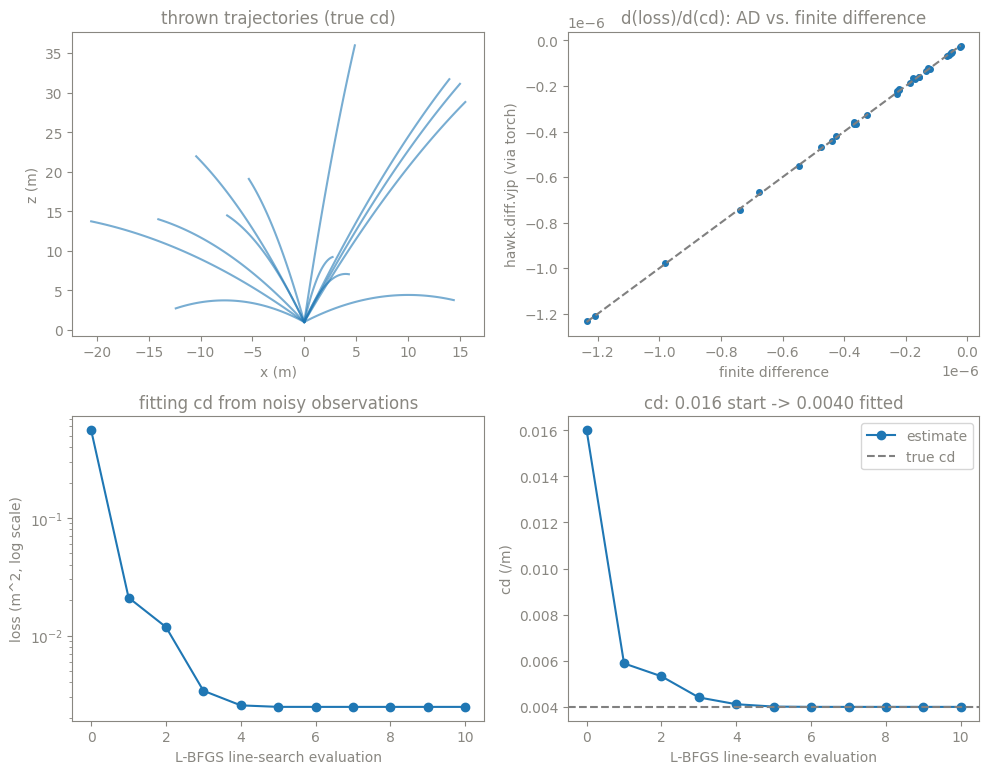
Thrown trajectories at the true cd, the AD-vs-finite-difference check
from earlier, the loss curve, and the fitted cd converging to the true
value:
What just happened#
One
Kindhierarchy and one custom primitive fed TWO kernels:flight_sim(reads its own state before writing it, foreagle.simulate’s repeated launches) andflight_step(a pure per-launch function, for derivatives and PyTorch) — the same physics, two shapes for two jobs.hawk.diffrefuses to differentiate a kernel that carries state across launches;eagle.frameworks.torch.functiondifferentiates the pureflight_stepinstead, and its reverse- and forward-mode gradients land on the finite difference (gradcheckand a hand-rolled check both agree).cd’s gradient is too large for its own tiny scale, so plain SGD oncdovershoots past zero in one step; optimizinglog(cd)with L-BFGS instead recovers the true drag coefficient from noisy, simulated throws.
Try this#
Change v_crit and watch the learned cd drift if the model’s ramp no
longer matches the data’s — the fit is only as good as the physics it is
given.
Next#
eagle’s tutorials pick this up from the runtime side: graphs, compaction, and training at scale. Short a primitive, or need to splice raw C++ instead? See when hawk can’t spell it.