

Arguments and shapes#
Pick the plane type that matches your data — a vector, a matrix, a quaternion — and see how a batch of samples is laid out in memory.
Time: ~8 min · Runs on: CPU · You need: Your first kernel
A per-sample vector#
Vector[3] declares a 3-component per-sample input — a velocity, a
position, anything with 3 numbers per sample. hawk.math.cross is
ordinary vector algebra written against two of them. Build and run it
the same way Your first kernel does:
import numpy as np

import hawk
from hawk import Mutable, Vector
from hawk.math import cross


@hawk.kernel
def cross_product(a: Vector[3], b: Vector[3], out: Mutable[Vector[3]]):
    out = cross(a, b)


cross_product
<Kernel cross_product slots=3>
hawk.artifact.build + hawk.load/hawk.run compile and run it on the host:
import pathlib, tempfile

import hawk.artifact

work_dir = pathlib.Path(tempfile.mkdtemp())
a = np.array([[1.0, 0.0], [0.0, 1.0], [0.0, 0.0]])   # one column per sample
b = np.array([[0.0, 1.0], [1.0, 0.0], [0.0, 0.0]])
out = np.zeros((3, 2))
hawk.artifact.build(cross_product, work_dir, targets=("host",))
hawk.run(hawk.load(work_dir, "cross_product"), a=a, b=b, out=out)
print("a x b =\n", out)
a x b =
 [[ 0.  0.]
 [ 0.  0.]
 [ 1. -1.]]
Two samples went in (a, b each hold 2 columns) and two cross products
came out — every plane here already batches over samples, one kernel call
covers the whole set.
Try this: swap cross(a, b) for hawk.math.dot(a, b) and change
out’s annotation to Mutable[Scalar] — same two inputs, a different
vocabulary word, a different shape of result.
A per-sample matrix#
Matrix[3, 3] declares a 3x3 per-sample input, such as a rotation or an
inertia tensor. @ is matrix-vector multiplication, the same operator
NumPy uses.
from hawk import Matrix

@hawk.kernel
def rotate_by_matrix(spin: Matrix[3, 3], a: Vector[3], out: Mutable[Vector[3]]):
    out = spin @ a


spin = np.tile((2.0 * np.eye(3)).reshape(9, 1), (1, 2))   # see below: why (9, 2)
out = np.zeros((3, 2))
hawk.artifact.build(rotate_by_matrix, work_dir, targets=("host",))
hawk.run(hawk.load(work_dir, "rotate_by_matrix"), spin=spin, a=a, out=out)
print("spin @ a =\n", out)
spin @ a =
 [[2. 0.]
 [0. 2.]
 [0. 0.]]
Why the matrix array is shaped (9, n)#
A Matrix[R, C] plane is flat, (R*C, n), never (R, C, n) — one
row per matrix entry, in row-major order, same as every other plane
keeping one row per component. The same np.eye(3) reused for both
samples above hid that; here each sample gets a genuinely different
matrix, built by flattening a (n, 3, 3) array:
spins = [np.eye(3), np.diag([1.0, -1.0, 1.0])]            # two DIFFERENT 3x3 matrices
spin_flat = np.stack([m.ravel() for m in spins], axis=1)  # flatten, stack as columns

out2 = np.zeros((3, 2))
hawk.artifact.build(rotate_by_matrix, work_dir, targets=("host",))
hawk.run(hawk.load(work_dir, "rotate_by_matrix"), spin=spin_flat, a=a, out=out2)
print("spin @ a (two different matrices) =\n", out2)
spin @ a (two different matrices) =
 [[ 1.  0.]
 [ 0. -1.]
 [ 0.  0.]]
Combining what you have#
triad below reuses cross and @ from the cells above, plus one new
one-liner, hawk.math.dot (the dot product) — three named outputs from
one kernel, reusing the a, b and spin arrays already built above.
from hawk import Scalar
from hawk.math import dot

@hawk.kernel
def triad(a: Vector[3], b: Vector[3], spin: Matrix[3, 3],
          perp: Mutable[Vector[3]], along: Mutable[Scalar],
          spun: Mutable[Vector[3]]):
    perp = cross(a, b)
    along = dot(a, b)
    spun = spin @ a


triad
<Kernel triad slots=6>
Build and run it the same way:
perp, along, spun = np.zeros((3, 2)), np.zeros(2), np.zeros((3, 2))
hawk.artifact.build(triad, work_dir, targets=("host",))
hawk.run(hawk.load(work_dir, "triad"), a=a, b=b, spin=spin,
       perp=perp, along=along, spun=spun)
print("a x b   =\n", perp)
print("a . b   =", along)
print("spin @ a =\n", spun)
a x b   =
 [[ 0.  0.]
 [ 0.  0.]
 [ 1. -1.]]
a . b   = [0. 0.]
spin @ a =
 [[2. 0.]
 [0. 2.]
 [0. 0.]]
A quaternion rotates a vector#
Quat is a plain 4-component plane, like any other; quat_rotate(q, v)
rotates v by q.
from hawk import Quat
from hawk.math import quat_rotate


@hawk.kernel
def apply_rotation(q: Quat, v: Vector[3], out: Mutable[Vector[3]]):
    out = quat_rotate(q, v)


apply_rotation
<Kernel apply_rotation slots=3>
Build and run it on a single sample:
# a 90-degree rotation about z: q = (cos45, 0, 0, sin45), (w, x, y, z)
q = np.array([[np.cos(np.pi / 4)], [0.0], [0.0], [np.sin(np.pi / 4)]])
v = np.array([[1.0], [0.0], [0.0]])
out = np.zeros((3, 1))
hawk.artifact.build(apply_rotation, work_dir, targets=("host",))
hawk.run(hawk.load(work_dir, "apply_rotation"), q=q, v=v, out=out)
print("rotated (1, 0, 0) by 90 deg about z:", out.ravel())
rotated (1, 0, 0) by 90 deg about z: [2.22044605e-16 1.00000000e+00 0.00000000e+00]
The same plane, a different array layout#
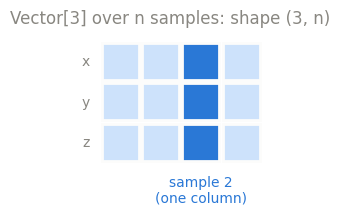
Every vector plane above was component-major: Vector[3] over n
samples is (3, n), one contiguous row per component. Most array code
keeps per-sample vectors the other way round, (n, 3). hawk.run
accepts that layout too, with no copy, exactly when it is a
transposed view of a component-major array:
from hawk.math import norm

@hawk.kernel
def speed(v: Vector[3], out: Mutable[Scalar]):
    out = norm(v)


speed
<Kernel speed slots=2>
Build it once, then bind both array layouts to the same kernel:
n = 4
v_component_major = np.random.default_rng(0).normal(size=(3, n))   # (3, n)

hawk.artifact.build(speed, work_dir, targets=("host",))
speed_host = hawk.load(work_dir, "speed")
out_a = np.zeros(n)
hawk.run(speed_host, v=v_component_major, out=out_a)

v_sample_major = v_component_major.T        # (n, 3) VIEW, no copy taken
out_b = np.zeros(n)
hawk.run(speed_host, v=v_sample_major, out=out_b)      # bound directly, same bytes
print("same result from (3, n) and its (n, 3) view:", np.allclose(out_a, out_b))
print("zero-copy:", np.shares_memory(v_sample_major, v_component_major))
same result from (3, n) and its (n, 3) view: True
zero-copy: True
A plot makes the (3, n) layout concrete — one highlighted column is one
sample, carrying all 3 of its components:
Any other (n, 3) array (a plain C-contiguous one, say) would need a
real copy, so hawk.run refuses it outright rather than silently
copying — naming the argument and the fix
(np.ascontiguousarray(x.T)), per Interoperability.
What just happened#
Vector[3],Matrix[3, 3]andQuatdeclare per-sample inputs the same wayScalardoes;hawk.math.{cross, dot, norm, quat_rotate}write the vector algebra a body needs, and a kernel can combine several of them into one call with several named outputs.A
Matrix[R, C]plane is flat ((R*C, n)), built by flattening each sample’s matrix and stacking the flattened rows as columns — never a 3-D array.hawk.runalso binds the sample-major(n, 3)layout most array code uses, with no copy, exactly when it is a transposed view of a component-major array.
Going deeper (optional)#
A kernel need not commit only through a named Mutable parameter: ending
its body with return <expr> commits into a slot a declared Kind names.
Writing a vocabulary covers Kind
in full; this is only the shape of it:
from hawk.ext import Kind, Output

ACCEL = Kind("accel_teaser", output=Output.returned(Vector[3], slot="acc"))

@ACCEL
def tiny_drag(velocity: Vector[3], k: Param):
    return (-k) * velocity    # commits into the synthesised "acc" slot
Next#
Stop when you’re done — write a kernel that steps itself until each sample finishes, and run one trajectory on the CPU or a million on the GPU with the same call.