

Writing a vocabulary I: a family of kernels#
Declare a kernel’s shape once; write every model in the family as a one-line function body.
Time: ~5 min · Runs on: CPU (same code on GPU) · You need: hawk basics
A vocabulary is the named per-sample arrays and parameters a whole
family of kernels shares — every orbit model in a propagator needs a
position, a velocity, a timestep and gravity, say. Declare that shape
once as a Kind, and every model in the family becomes a plain function
body decorated with it.
Declaring the shape#
slug="orbit" names this Kind for build artifacts and diagnostics —
every kernel built from it shows up tagged orbit. guard = DATA_ONLY
runs every sample unconditionally; no stopping rule yet, that is a later
tutorial’s terminated mask.
import hawk
from hawk import Mutable, Param, Vector
from hawk.ext import DATA_ONLY, KernelKind


class Orbit(KernelKind, slug="orbit"):
    r: Vector[3]
    v: Vector[3]
    dt: Param
    g: Param
    guard = DATA_ONLY


Orbit
__main__.Orbit
A model built on Orbit is a plain function, decorated @Orbit, that
reads r, v, dt, g without redeclaring any of them:
import numpy as np
from hawk.math import vec


@Orbit
def free_fall(r, v, dt, g, r_next: Mutable[Vector[3]], v_next: Mutable[Vector[3]]):
    v_new = v + dt * vec(0.0, 0.0, -g)
    v_next = v_new
    r_next = r + dt * v_new


free_fall
<Kernel free_fall slots=6>
hawk.artifact.build + hawk.load/hawk.run build and run it on the host:
import pathlib, tempfile

import hawk.artifact

work_dir = pathlib.Path(tempfile.mkdtemp())
n = 200
r0 = np.zeros((3, n)); r0[2] = 2.0
rng = np.random.default_rng(0)
v0 = np.zeros((3, n)); v0[0] = rng.uniform(1.0, 4.0, n)
r_next, v_next = np.zeros((3, n)), np.zeros((3, n))
hawk.artifact.build(free_fall, work_dir, targets=("host",))
hawk.run(hawk.load(work_dir, "free_fall"), r=r0, v=v0, dt=0.2, g=9.81,
       r_next=r_next, v_next=v_next)
print("free_fall, x after one step (first 3 samples):", r_next[0, :3])
free_fall, x after one step (first 3 samples): [0.58217701 0.36187203 0.22458411]
A second model can add its own extra parameter on top of the shared
shape — tethered below adds a spring constant k:
@Orbit
def tethered(r, v, dt, g, k: Param,
             r_next: Mutable[Vector[3]], v_next: Mutable[Vector[3]]):
    a = vec(0.0, 0.0, -g) - k * r              # a spring pulling back to the origin
    v_new = v + dt * a
    v_next = v_new
    r_next = r + dt * v_new


hawk.artifact.build(tethered, work_dir, targets=("host",));
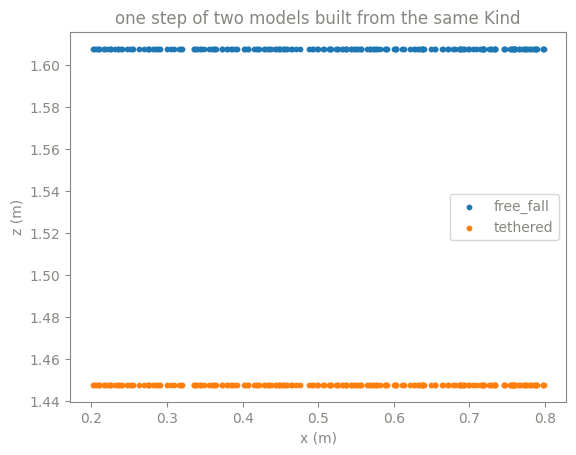
Both kernels built from the same Kind; tethered’s k is declared
only for that one model. Run a batch of each for one step and plot
where they land.
def run(kernel_name, **extra):
    r_next, v_next = np.zeros((3, n)), np.zeros((3, n))
    kernel_host = hawk.load(work_dir, kernel_name)
    hawk.run(kernel_host, r=r0, v=v0, dt=0.2, g=9.81,
           r_next=r_next, v_next=v_next, **extra)
    return r_next


falling = run("free_fall")
tethered_r = run("tethered", k=2.0)   # k: one broadcast value, not per-sample
The one-line spelling#
class Orbit(KernelKind, ...) is sugar over one Kind(...) call — the
same object either way, so every downstream consumer sees the identical
Kind:
from hawk.ext import Kind

Orbit_oneline = Kind("orbit",
                      vocabulary=dict(r=Vector[3], v=Vector[3], dt=Param, g=Param),
                      guard=DATA_ONLY)
Orbit_oneline == Orbit.kind
True
What just happened#
Orbitdeclared ONE shared shape (r, v, dt, g);free_fallandtetheredare plain function bodies, each decorated@Orbit.Every kernel can still add its own parameters too —
tethered’skis not shared, only declared for that one model.guard = DATA_ONLYruns every sample unconditionally; a later tutorial’sterminatedmask is what lets a kernel stop on its own.
Try this#
Add a third @Orbit model, drift, with no acceleration at all
(v_next = v; r_next = r + dt * v) — no new vocabulary, just another
function body.
Next#
Extend it by inheritance — add a drag
coefficient to Orbit without touching it. Deeper: every kind field
(output, sink, guard) in the
hawk.ext API reference.