

Gradients, backward#
Get d(output)/d(input) for every sample — no hand-derived formula.
Time: ~8 min · Runs on: CPU · You need: Arguments and shapes
hawk.diff.vjp (“vector-Jacobian product”: the Jacobian is the matrix of
every output’s derivative with respect to every input; vjp returns that
matrix applied to a seed, without ever building it) reads a kernel’s own
intermediate representation (IR) and derives a new IR for its
gradient — no recorded tape (a log of operations replayed backward, the
way some other autodiff systems work; hawk keeps none).
import hawk
from hawk import Mutable, Scalar, Vector
from hawk.math import dot


@hawk.kernel
def energy(v: Vector[3], out: Mutable[Scalar]):   # out: where the result lands
    out = 0.5 * dot(v, v)


energy
<Kernel energy slots=2>
Deriving the backward kernel#
vjp(primal, wrt=...) derives the backward IR for energy’s gradient
with respect to the names in wrt; Kernel(name, ir) names it so it
can be built like any other kernel (the optional third argument,
planes, declares extra planes a derived kernel never needs):
from hawk import Kernel
from hawk.diff import vjp

energy_vjp = Kernel("energy_vjp", vjp(energy, wrt=("v",)))
energy_vjp
<Kernel energy_vjp slots=3>
Running it: bar_<name>#
A derived gradient kernel is an ordinary kernel: build it, run it.
bar_<name> is hawk’s adjoint (reverse-mode derivative) naming
convention, used throughout the family: bar_out is the derivative of
the sink out (the seed — “how much does the loss change per unit of
out”; 1 for every sample means “treat out itself as the loss”), and
bar_v receives the derivative with respect to the input v.
import pathlib, tempfile
import numpy as np


work_dir = pathlib.Path(tempfile.mkdtemp())
hawk.build([energy, energy_vjp], work_dir, targets=("host",))

n = 4
v = np.array([[1.0, 2.0, 3.0, 4.0], [0.0, 1.0, 0.0, 1.0], [0.0, 0.0, 1.0, 1.0]])
e = np.zeros(n)
hawk.run(hawk.load(work_dir, "energy"), v=v, out=e)
print("energy:", e)
energy: [0.5 2.5 5. 9. ]
bar_out = np.ones(n)        # seed: d(loss)/d(energy) = 1 for every sample
bar_v = np.zeros((3, n))    # receives d(energy)/d(v)
hawk.run(hawk.load(work_dir, "energy_vjp"), v=v, bar_out=bar_out, bar_v=bar_v)
print("gradient d(energy)/dv:\n", bar_v)
gradient d(energy)/dv:
 [[1. 2. 3. 4.]
 [0. 1. 0. 1.]
 [0. 0. 1. 1.]]
Here energy = 0.5 |v|^2, so d(energy)/dv = v exactly — the printed
gradient above is the input.
Checking it against finite differences#
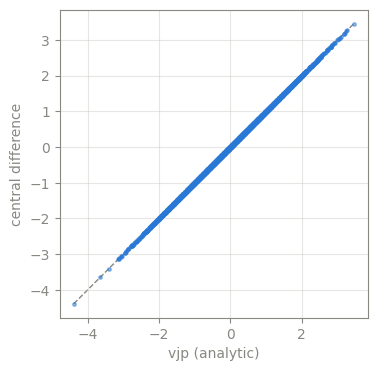
The standard sanity check for any derivative, hand-derived or not: compare it to a central finite difference of the compiled primal kernel itself.
def run_energy(v):
    out = np.zeros(v.shape[1])
    hawk.run(hawk.load(work_dir, "energy"), v=v, out=out)
    return out


def run_grad(v):
    n = v.shape[1]
    bar_out, bar_v = np.ones(n), np.zeros((3, n))
    hawk.run(hawk.load(work_dir, "energy_vjp"), v=v, bar_out=bar_out, bar_v=bar_v)
    return bar_v
rng = np.random.default_rng(42)
n = 2000
v_batch = rng.normal(size=(3, n))
analytic = run_grad(v_batch)

h = 1e-6
numeric = np.zeros_like(v_batch)
for axis in range(3):
    plus, minus = v_batch.copy(), v_batch.copy()
    plus[axis] += h
    minus[axis] -= h
    numeric[axis] = (run_energy(plus) - run_energy(minus)) / (2 * h)

max_abs_error = np.max(np.abs(analytic - numeric))
msg = f"{n} samples x 3 components, max|analytic - central diff| = {max_abs_error:.3e}"
print(msg)
2000 samples x 3 components, max|analytic - central diff| = 9.426e-10
What just happened#
hawk.diff.vjp(primal, wrt=...)derives a backward kernel from the primal’s own IR — no recorded tape, no hand-written formula.bar_outseeds the adjoint of a sink;bar_vreceives the adjoint with respect to an input — thebar_<name>convention hawk uses everywhere.A derived gradient is an ordinary kernel: build it, run it, and check it against a central finite difference of the compiled primal, the same way you would check a hand derivation.
Try this#
Change the seed bar_out = np.ones(n) to bar_out = np.full(n, 2.0) and
re-run: every gradient doubles, since vjp is linear in its seed.
Next#
Gradients, forward — push a direction through the same kernel instead, and see which kernels autodiff refuses to differentiate at all.