

Lookups, scatters and sums#
Read a table, scatter into shared bins, and let each sample total its own contributions — three plane kinds every earlier tutorial skipped.
Time: ~8 min · Runs on: CPU · You need: Stop when you’re done
Table: a per-sample lookup#
Table[...] is a per-sample lookup, read with .at(index) through an
Index plane. Every sample here reads a DIFFERENT table entry, by its
own index:
import numpy as np

import hawk
from hawk import Index, Mutable, Scalar, Table


@hawk.kernel
def gather(table: Table[Scalar], where: Index, y: Mutable[Scalar]):
    y = table.at(where)


gather
<Kernel gather slots=3>
hawk.artifact.build + hawk.load/hawk.run build and run it on the host:
import pathlib, tempfile

import hawk.artifact

work_dir = pathlib.Path(tempfile.mkdtemp())
n = 8
table_vals = np.arange(n, dtype=float) * 3.0
where = ((np.arange(n) * 7 + 3) % n).astype(np.int64)   # Index plane: int64, not int32
y = np.zeros(n)
hawk.artifact.build(gather, work_dir, targets=("host",))
hawk.run(hawk.load(work_dir, "gather"), table=table_vals, where=where, y=y)
print("gather:", y)
gather: [ 9. 6. 3. 0. 21. 18. 15. 12.]
where is int64 on purpose: an Index plane drives a real memory
address, as the refusal at the end of this page shows.
Accum: a cross-sample scatter#
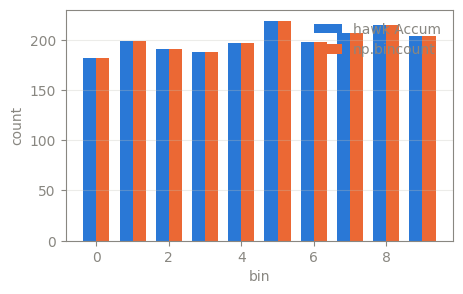
Accum[...] is a cross-sample scatter, written with .add(value, at=lane) — many samples can land in the same bin, like a histogram:
from hawk import Accum

rng = np.random.default_rng(0)


@hawk.kernel
def histogram(lane: Index, acc: Accum[Scalar]):
    acc.add(1.0, at=lane)


histogram
<Kernel histogram slots=2>
Build and run it the same way:
n_samples, n_bins = 2000, 10
lane = rng.integers(0, n_bins, size=n_samples).astype(np.int64)
acc = np.zeros(n_bins)
hawk.artifact.build(histogram, work_dir, targets=("host",))
hawk.run(hawk.load(work_dir, "histogram"), lane=lane, acc=acc)
expect = np.bincount(lane, minlength=n_bins).astype(float)
print("Accum matches np.bincount:", np.allclose(acc, expect))
Accum matches np.bincount: True
Reduce: one slot per sample, not one running total#
Reduce("sum") takes parentheses, not brackets like Table[...]:
its argument is the combine op’s name, resolved when hawk traces the
kernel (turns it into IR, before it ever runs), not a type.
.contribute(value) writes into a mapreduce slot — one accumulator
per sample that every .contribute call in the body adds into, the same
idea a true map-reduce combines partial results with, just scoped to one
sample instead of a whole cluster:
from hawk import Reduce, Vector
from hawk.math import dot


@hawk.kernel
def energy(v: Vector[3], total: Reduce("sum")):
    total.contribute(dot(v, v))


energy
<Kernel energy slots=2>
Build and run it:
n = 8
v = rng.normal(size=(3, n))
total = np.zeros(n)
hawk.artifact.build(energy, work_dir, targets=("host",))
hawk.run(hawk.load(work_dir, "energy"), v=v, total=total)
print("energy, one slot per sample:", total)
energy, one slot per sample: [1.37902901 2.90811709 8.98823442 0.99007907 4.01012216 7.65868338
 3.10053932 1.59897325]
A value carried across several launches#
The same bound best array, the same kernel, called once per step: each
launch reads the value the previous launch committed, simply by
reading best before writing it — the same convention
Stop when you’re done used to step a
trajectory:
from hawk import Terminated
from hawk.math import maximum


@hawk.kernel
def running_max(value: Scalar, terminated: Terminated, best: Mutable[Scalar]):
    best = maximum(best, value)


running_max
<Kernel running_max slots=3>
Build it once, then call it five times, reading best back each time:
hawk.artifact.build(running_max, work_dir, targets=("host",))
running_max_k = hawk.load(work_dir, "running_max")
best = np.zeros(n)
terminated = np.zeros(n, dtype=bool)
for value in (3.0, 7.0, 2.0, 9.0, 4.0):
    hawk.run(running_max_k, value=np.full(n, value), terminated=terminated, best=best)
print("running max after 5 launches (expect 9.0 everywhere):", best)
running max after 5 launches (expect 9.0 everywhere): [9. 9. 9. 9. 9. 9. 9. 9.]
A wrong binding, refused by name#
hawk.run checks every bound argument against the kernel’s own
declaration before taking its address — the SAME gather kernel from
above, with where bound as int32 instead of int64:
from hawk.ir import HawkError

gather_host = hawk.load(work_dir, "gather")
try:
    hawk.run(gather_host, table=table_vals, where=where.astype(np.int32), y=y)
except HawkError as exc:
    print("refused:", exc)
refused: kernel 'gather': argument 'where': expected dtype int64, got int32 — pass np.asarray(where, dtype=np.int64)
What just happened#
Table[...].at(index)is a per-sample lookup;Accum[...].add(value, at=lane)scatters across samples into shared bins;Reduce("sum")gives each sample its own mapreduce slot — three different ways data crosses between samples, none of them a hidden Python loop.Indexplanes (where,lane) are alwaysint64; a wrong dtype is refused by name rather than silently misread.Reading a
Mutablebefore writing it carries a value from one launch to the next — the same mechanism Stop when you’re done used to step a trajectory, here running a max across five launches.
Try this#
Change Reduce("sum") to add a second contribution (say total.contribute(1.0)
in a second statement) and check that total becomes energy + 1 for
every sample — a mapreduce slot accumulates everything a launch
contributes to it.
Next#
Writing a vocabulary — declare a reusable kernel shape once, so a whole family of models shares one vocabulary. Deeper: the API reference for every plane kind and sink policy.