

The eagle batch inside jit#
Your whole simulation is one jitted JAX program, and the eagle kernel is just an op in its loop.
osc_step = eagle_jax.function(osc)                                    # a hawk kernel as a JAX function
run = jax.jit(lambda c: lax.while_loop(running, lambda s: advance(c, s), start))
jax.grad(lambda c: lax.scan(lambda s, _: (advance(c, s), None), start, None, length=200)[0][0].sum())(0.3)
Time: ~5 min · Runs on: CPU, GPU if visible (picked up automatically) · You need: eagle, hawk and JAX
Colab or Kaggle: run this first cell (it installs the packages and downloads the helper files this notebook uses). Elsewhere it only checks the imports.
import sys, pathlib
sys.path.insert(0, str(pathlib.Path.cwd().parent.parent / "_shared"))
from nb_helpers import plot_style
plot_style()
/dev/shm/jaxprobe/venv/lib/python3.12/site-packages/cupy/_environment.py:677: UserWarning:
--------------------------------------------------------------------------------

  CuPy may not function correctly because multiple CuPy packages are installed
  in your environment:

    cupy, cupy-cuda12x

  Follow these steps to resolve this issue:

    1. For all packages listed above, run the following command to remove all
       existing CuPy installations:

         $ pip uninstall <package_name>

      If you previously installed CuPy via conda, also run the following:

         $ conda uninstall cupy

    2. Install the appropriate CuPy package.
       Refer to the Installation Guide for detailed instructions.

         https://docs.cupy.dev/en/stable/install.html

--------------------------------------------------------------------------------

  warnings.warn(f'''
A kernel that carries its state#
512 damped oscillators, each stopping at its own final time. The kernel reads and writes x, v and t: that is
its state, and it is handed from one step to the next. When a kernel carries state, the JAX function returns it
aliased to the input you passed, and a stopped oscillator keeps its value. So the loop body needs no where.
import os

os.environ.setdefault("XLA_PYTHON_CLIENT_PREALLOCATE", "false")  # leave GPU memory for your other libraries
try:  # CUDA 13: CuPy loads NVRTC before JAX does (see Limits on the JAX page)
    import cupy
    cupy.cuda.nvrtc.getVersion()
except Exception:  # no CuPy or no CUDA here
    pass
import jax
import jax.numpy as jnp
import numpy as np
from jax import lax

jax.config.update("jax_enable_x64", True)

import hawk
from hawk import Mutable, Param, Scalar, Terminated

import eagle
import eagle.plan
from eagle.frameworks import jax as eagle_jax

N, DT = 512, 0.01


@hawk.kernel(steps=1)
def osc(dt: Param, c: Param, t_final: Scalar, terminated: Terminated,
        x: Mutable[Scalar], v: Mutable[Scalar], t: Mutable[Scalar]):
    vn = v - dt * (x + c * v)
    x = x + dt * v
    v = vn
    tn = t + dt
    t = tn
    terminated = tn >= t_final

osc_step = eagle_jax.function(osc)
print("inputs: ", osc_step.inputs)
print("outputs:", osc_step.outputs)
inputs:  ('dt', 'c', 't_final', 'terminated', 'x', 'v', 't')
outputs: ('t', 'v', 'x', 'terminated')
The kernel’s own order is the contract: inputs as declared, outputs sorted by name with the finished mask last. A
small advance function keeps that bookkeeping in one place.
x0, v0 = jnp.linspace(0.5, 1.5, N), jnp.linspace(-0.2, 0.3, N)
t_final = jnp.linspace(0.5, 2.0, N)
start = (x0, v0, jnp.zeros(N), jnp.zeros(N, bool))


def advance(c, state):
    x, v, t, done = state
    t, v, x, done = osc_step(DT, c, t_final, done, x, v, t)     # the outputs, in the order printed above
    return x, v, t, done


@jax.jit
def run(c):
    return lax.while_loop(lambda s: ~jnp.all(s[3]), lambda s: advance(c, s), start)


x, v, t, done = run(0.3)
print("all stopped:", bool(done.all()), "| mean final position:", float(x.mean()))
all stopped: True | mean final position: 0.3250628958564831
The same bits as eagle’s own loop#
while_loop is XLA’s loop and until_done is eagle’s, but they run the same kernel. Here is the batch again through
until_done, compared plane by plane:
gpu = jax.default_backend() == "gpu"
if gpu:
    import cupy as xp
else:
    xp = np
(plan,) = eagle.plan.auto([osc], targets=("cuda" if gpu else "host",))
own = dict(x=xp.asarray(x0).copy(), v=xp.asarray(v0).copy(), t=xp.zeros(N), t_final=xp.asarray(t_final))
report = eagle.run_until_done(plan, max_steps=400, dt=DT, c=0.3, terminated=xp.zeros(N, bool), **own)
same = np.array_equal(own["x"].get() if gpu else own["x"], np.asarray(x))
print(f"until_done: {report.steps} steps; identical to the while_loop run: {same}")
assert same
until_done: 200 steps; identical to the while_loop run: True
Sweep a parameter#
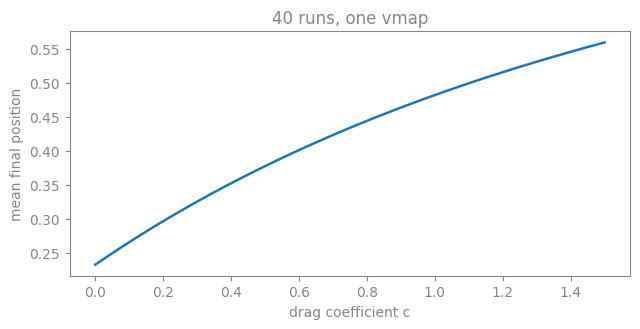
run is an ordinary jitted function of the drag coefficient, so a sweep is one vmap over it: the 40 runs go through
the same compiled loop, and it stops when the slowest one has finished.
import matplotlib.pyplot as plt

drags = np.linspace(0.0, 1.5, 40)
final_x = jax.jit(jax.vmap(lambda c: run(c)[0].mean()))(drags)

fig, ax = plt.subplots(figsize=(6.5, 3.4))
ax.plot(drags, final_x, lw=1.8)
ax.set(xlabel="drag coefficient c", ylabel="mean final position", title="40 runs, one vmap")
plt.tight_layout()
A gradient with no where#
For gradients, swap while_loop for lax.scan with a fixed length: JAX differentiates scans, and eagle’s rule for a
carried-state kernel treats a stopped oscillator as passing its gradient straight through. The check is the same loop
written in jax.numpy with the where spelled out.
LENGTH = 200      # 200 steps of 0.01 reach the longest final time, 2.0


def mean_x(c):
    final = lax.scan(lambda s, _: (advance(c, s), None), start, None, length=LENGTH)[0]
    return final[0].sum()


def mean_x_reference(c):
    def body(s, _):
        x, v, t, done = s
        vn, xn, tn = v - DT * (x + c * v), x + DT * v, t + DT
        return (jnp.where(done, x, xn), jnp.where(done, v, vn), jnp.where(done, t, tn), done | (tn >= t_final)), None
    return lax.scan(body, start, None, length=LENGTH)[0][0].sum()


g, g_ref = jax.jit(jax.grad(mean_x))(0.3), jax.jit(jax.grad(mean_x_reference))(0.3)
rel = abs(float(g) - float(g_ref)) / abs(float(g_ref))
print(f"d(sum x)/dc = {float(g):.6f}; plain JAX {float(g_ref):.6f}; relative difference {rel:.1e}")
assert rel < 1e-12
d(sum x)/dc = 142.827573; plain JAX 142.827573; relative difference 2.0e-16
What stays outside jit#
Inside jit the loop belongs to XLA, so until_done’s own tools (compaction of finished samples, conditionals, event
refinement, windowed reverse) are not there; they are the reason to stay with until_done and put a JAX model in it
as in tutorial 17. JAX’s loops also set what is differentiable. Here is what
you get if you try, the first line of each message:
def first_line(call):
    try:
        call()
    except Exception as err:
        return f"{type(err).__name__}: {str(err).splitlines()[0][:120]}"
    return "worked"


print("grad through while_loop:", first_line(lambda: jax.grad(lambda c: run(c)[0].sum())(0.3)))
print("forward mode:           ", first_line(lambda: jax.jacfwd(mean_x)(0.3)))
print("reverse Jacobian:       ", first_line(lambda: jax.jacrev(mean_x)(0.3)))
grad through while_loop: ValueError: Reverse-mode differentiation does not work for lax.while_loop or lax.fori_loop with dynamic start/stop values. Try using
forward mode:            TypeError: can't apply forward-mode autodiff (jvp) to a custom_vjp function.
reverse Jacobian:        worked
Limits#
- Compaction, conditionals and event refinement belong to `until_done`; inside `jit` the loop is XLA's (`while_loop`, `scan`), so they do not apply there (XLA's design): use `until_done` when you need them.
- `jax.grad` does not go through `lax.while_loop`, because the trip count is only known at run time (JAX's rule): use `lax.scan` with a fixed length for gradients, as this page does.
- Forward mode (`jvp`, `jacfwd`) of a kernel that carries state is not available yet (our scope): use reverse mode (`grad`, `jacrev`), or a kernel that writes a separate output plane.
Which one when#
Mostly eagle with a JAX model in the loop: tutorial 17, where eagle keeps
compaction, events and reverse. Mostly JAX with eagle kernels as ops: this page, with while_loop to run and scan
to differentiate. eagle inside your JAX program has the full picture.