

Build a step as a graph: eagle.Graph#
Write a step once as nodes, let eagle work out what depends on what, then look at it, run it, and watch it refuse the mistakes that would otherwise race.
Time: ~8 min · Runs on: CPU (the same cells lower to a captured CUDA graph when the planes are cupy arrays) · You need: eagle, hawk and NumPy; read first: Thirty seconds: eagle.simulate, The graph model: eagle.Graph
You will end with a picture: a seed feeding two parallel branches that join inside a conditional, drawn by eagle itself.
Colab or Kaggle: run this first cell (it installs the packages and downloads the helper files this notebook uses). Elsewhere it only checks the imports.
A graph from two launches#
We start with real kernels. Two small hawk
kernels, built into plans and bound over arrays of our own: y = a * x, then
z = y + 1.
import tempfile
import hawk
from hawk import Mutable, Param, Scalar


@hawk.kernel
def scale(x: Scalar, a: Param, y: Mutable[Scalar]):
    y = a * x


@hawk.kernel
def shift(x: Scalar, y: Mutable[Scalar]):
    y = x + 1.0


scale_plan, shift_plan = eagle.deploy([scale, shift], targets=("host",),
                                      cache_dir=tempfile.mkdtemp())
x = np.arange(8.0)
y = np.zeros(8)
z = np.zeros(8)

g = eagle.Graph()
g.add(scale_plan.bind(x=x, a=2.0, y=y), name="scale")
g.add(shift_plan.bind(x=y, y=z), name="shift")
print(repr(g))
<eagle.Graph 2 nodes, 2 stages, unbuilt>
We never said that shift has to wait for scale. shift reads y, scale
writes it, and eagle sees that from the arrays themselves. Ask for the edges:
for edge in g.edges():
    print(edge)
Edge(src=0, dst=1, plane='y', kind='RAW')
One edge, scale -> shift on the plane y, a RAW (read-after-write)
dependency. Now look at the whole graph:
g.show()
eagle.Graph  2 nodes · 0 groups · backend: (not built)

  stage 0 ┌───────┐
          │ scale │
          └───┬───┘
              y
              │
  stage 1 ┌───┴───┐
          │ shift │
          └───────┘
show() works on the graph as it stands, before it is built. Build it, launch
it, and check the answer:
g.build().launch()
print("backend:", g.backend, "| schedule:", g.schedule)
print("z == 2x + 1:", bool(np.array_equal(z, 2 * x + 1)))
g.show()
backend: cpu | schedule: ('work_share', 'work_share')
z == 2x + 1: True
eagle.Graph  2 nodes · 0 groups · backend: cpu

  stage 0 work_share ┌───────┐
                     │ scale │
                     └───┬───┘
                         y
                         │
  stage 1 work_share ┌───┴───┐
                     │ shift │
                     └───────┘
After build() the picture also says how each stage runs: work_share is the
CPU lowering, capture is what a GPU build prints.
Fork and join#
Two independent pieces of work can share a stage. Here two opaque ops (any
callable you can run, with the arrays it touches declared) both read base
and write their own result; a third node combines them.
base = np.linspace(0.0, 1.0, 8)
left, right, total = np.zeros(8), np.zeros(8), np.zeros(8)

fork = eagle.Graph()
fork.add_group([
    opaque(lambda: np.square(base, out=left), reads={"base": base}, writes={"left": left}),
    opaque(lambda: np.sqrt(base, out=right), reads={"base": base}, writes={"right": right}),
], names=["square", "root"])
fork.add_node(opaque(lambda: np.add(left, right, out=total),
                     reads={"left": left, "right": right}, writes={"total": total}),
              name="combine")
fork.build().launch()
print(fork)
eagle.Graph  3 nodes · 1 group · backend: cpu

  stage 0 work_share ┌╌╌╌╌╌╌╌╌╌┐   ┌╌╌╌╌╌╌╌┐
                     ╎ square  ╎   ╎ root  ╎
                     └╌╌╌╌┬╌╌╌╌┘   └╌╌╌┬╌╌╌┘
                          left         right
                          └─────┬──────┘
  stage 1 work_share       ┌╌╌╌╌┴╌╌╌╌┐
                           ╎ combine ╎
                           └╌╌╌╌╌╌╌╌╌┘
Both branches sit on stage 0 and combine on stage 1: no edge between the
branches, an edge from each into combine. The branches only read base, so
sharing it is fine.
What a conflict looks like#
Now make the branches fight: both write the same array. On a GPU that is a
race; on the CPU it would silently depend on order. Either way eagle refuses it
at build(), naming both nodes and both planes.
shared = np.zeros(8)
racy = eagle.Graph().add_group([
    opaque(lambda: None, writes={"first_out": shared}),
    opaque(lambda: None, reads={"second_in": shared[2:]}),
], names=["first", "second"])
try:
    racy.build()
except ValueError as err:
    print(err)
eagle.Graph.build: 'first' (node 0) and 'second' (node 1) are siblings of one fork/join group but overlap (RAW): 'first' plane 'first_out' and 'second' plane 'second_in' share memory; give each branch its own plane, or order them in one branch
The check is about bytes, not names: shared[2:] is a different Python object
and a different name, but it overlaps. It is also stride-aware, so views that
only look close do not trip it:
evens_odds = eagle.Graph().add_group([
    opaque(lambda: None, writes={"even": shared[::2]}),
    opaque(lambda: None, writes={"odd": shared[1::2]}),
]).build()
print("interleaved halves of one array: fine, built on", evens_odds.backend)
interleaved halves of one array: fine, built on cpu
Conditionals#
A step that only sometimes runs is the eagle.skippable you already know. Give
it a node (so its planes are declared) and add it to the graph. A guard is a
count in an array: the step runs while it is non-zero. eagle.repeat_while
loops the same way, up to a cap.
field = np.zeros(4)
flag = np.array([1], dtype=np.uint32)        # non-zero: run
ticks = []


def refine():
    ticks.append(1)
    field[:] += 1.0
    flag[0] = 0                               # one pass is enough


guarded = (eagle.Graph()
           .add_node(opaque(lambda: field.fill(0.0), writes={"field": field}), name="reset")
           .add_node(eagle.skippable(opaque(refine, reads={"field": field}, writes={"field": field}),
                                     eagle.SkipGuard.nonzero(flag)), name="refine")
           .build())
guarded.launch()
print("refine ran", len(ticks), "time(s); field =", field)
guarded.launch()
print("flag is 0 now, so refine is skipped: still", len(ticks), "run; field =", field)
guarded.show()
refine ran 1 time(s); field = [1. 1. 1. 1.]
flag is 0 now, so refine is skipped: still 1 run; field = [0. 0. 0. 0.]
eagle.Graph  2 nodes · 0 groups · backend: cpu

  stage 0 work_share      ┌╌╌╌╌╌╌╌┐
                          ╎ reset ╎
                          └╌╌╌┬╌╌╌┘
                              field,fiel…
                              │
                     ╭─ skip if guard ─╮
  stage 1 work_share │ ┌╌╌╌╌╌╌┴╌╌╌╌╌╌┐ │
                     │ ╎   refine    ╎ │
                     │ └╌╌╌╌╌╌╌╌╌╌╌╌╌┘ │
                     ╰─────────────────╯
The frame is the conditional and carries its label. A loop prints as
repeat ≤ N. The guard is read at launch, never baked in at build, so the
second launch() skips the step without rebuilding anything.
One graph, several threads#
Distinct graphs run at once. One graph shared by two threads is for one caller
at a time, and the second is told so with eagle.Busy instead of being queued
or handed a half-run state. Here a slow node holds the graph while another
thread tries to launch it (and a third just looks at it, which never blocks):
import threading

entered, release = threading.Event(), threading.Event()


def slow():
    entered.set()
    release.wait(10)


shared_graph = eagle.Graph().add_node(opaque(slow, writes={"s": np.zeros(1)}), name="slow").build()
worker = threading.Thread(target=shared_graph.launch)
worker.start()
entered.wait(10)
try:
    shared_graph.launch()
except eagle.Busy as err:
    print("second caller:", err)
print("looking never blocks:", repr(shared_graph))
release.set()
worker.join()
second caller: eagle.Graph.launch: another call is still running on this Graph; give each thread its own Graph, or wait for it
looking never blocks: <eagle.Graph 1 nodes, 1 stages, cpu>
Seeing it#
g.show() is the text picture; str(g) returns the same text. For a figure,
g.plot() returns a matplotlib Figure (install it with
pip install "raptor-eagle[plot]"); for docs and tools there is Mermaid and
Graphviz. All of them come from one layout, so they always agree.
seed, a, b, out = (np.zeros(8) for _ in range(4))
flag2 = np.ones(1, dtype=np.uint32)
nop = lambda: None

pretty = eagle.Graph()
pretty.add_node(opaque(nop, writes={"x": seed}), name="seed")
pretty.add_group([opaque(nop, reads={"x": seed}, writes={"left_out": a}),
                  opaque(nop, reads={"x": seed}, writes={"right_out": b})],
                 names=["left", "right"])
pretty.add_node(eagle.skippable(
    opaque(nop, reads={"left_out": a, "right_out": b}, writes={"out": out}),
    eagle.SkipGuard.nonzero(flag2)), name="combine")
pretty.build()

import io
from IPython.display import Image

fig = pretty.plot()                      # a plain matplotlib Figure
buf = io.BytesIO()
fig.savefig(buf, format="png", dpi=100, bbox_inches="tight")
Image(buf.getvalue())
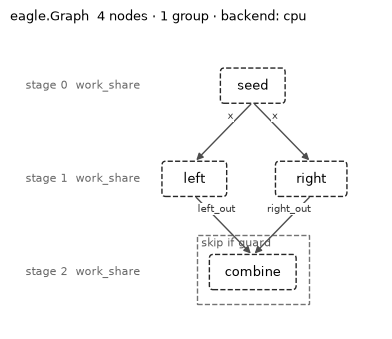
print(pretty.to_mermaid())
flowchart TD
  n0["seed<br/>work_share"]
  n1["left<br/>work_share"]
  n2["right<br/>work_share"]
  subgraph f0["skip if guard"]
    n3["combine<br/>work_share"]
  end
  n0 -->|"x"| n1
  n0 -->|"x"| n2
  n1 -->|"left_out"| n3
  n2 -->|"right_out"| n3
  classDef opaque stroke-dasharray: 4 2
  class n0,n1,n2,n3 opaque
What just happened#
You never declared an edge.
eagle.Graphread which arrays each node touches (on your own arrays, stride-aware) and derivedRAW/WAR/WAWedges, so adding a node cannot silently break an ordering.A fork/join group put independent branches on one stage, and a branch that would race with its sibling was refused at
build(), on every backend.eagle.skippableandeagle.repeat_whilewent in unchanged; the guard is read at launch, so one build serves every run.One graph, one caller at a time: a second thread gets
eagle.Busy, naming the method in flight, while looking at the graph takes no guard.show(),plot(),to_mermaid()andto_dot()all draw the same layout, built so far, without building or launching anything.
Try this#
Hand
forkcupy arrays instead of numpy ones (andcp.squarefor the ops):build()infers the GPU,fork.schedulebecomes("capture", ...), and the group is captured as parallel siblings.Add
fork.edges()to a cell: the three edges, and no edge between the branches.Make
racylegal by giving each branch its own array.
Next#
The graph model: eagle.Graph is the reference for everything used here. Seeing a graph from C++: eagle/graph shows the same engine drawing a C++ graph.