

Batches and Jacobians you already use#
vmap, jacfwd, jacrev and hessian work on a hawk kernel as they do on any JAX function. Some of them cost
one launch, some one per batch entry. This page shows which, then draws a loss surface with them.
Time: ~5 min · Runs on: CPU, GPU if visible (picked up automatically) · You need: eagle, hawk and JAX
You will build: the launch count of each transformation, a Jacobian two ways, and a map of a two-Param loss with its gradient arrows and curvature.
Colab or Kaggle: run this first cell (it installs the packages and downloads the helper files this notebook uses). Elsewhere it only checks the imports.
/dev/shm/jaxprobe/venv/lib/python3.12/site-packages/cupy/_environment.py:677: UserWarning:
--------------------------------------------------------------------------------

  CuPy may not function correctly because multiple CuPy packages are installed
  in your environment:

    cupy, cupy-cuda12x

  Follow these steps to resolve this issue:

    1. For all packages listed above, run the following command to remove all
       existing CuPy installations:

         $ pip uninstall <package_name>

      If you previously installed CuPy via conda, also run the following:

         $ conda uninstall cupy

    2. Install the appropriate CuPy package.
       Refer to the Installation Guide for detailed instructions.

         https://docs.cupy.dev/en/stable/install.html

--------------------------------------------------------------------------------

  warnings.warn(f'''
The kernel#
The same drag step as the training tutorial, with g a Param too, so there are two numbers to vary.
import os

os.environ.setdefault("XLA_PYTHON_CLIENT_PREALLOCATE", "false")  # leave GPU memory for your other libraries
import jax
import jax.numpy as jnp

jax.config.update("jax_enable_x64", True)  # the kernel runs in float64

import hawk
from hawk import Mutable, Param, Vector
from hawk.math import norm, vec

from eagle.frameworks import jax as eagle_jax


@hawk.kernel
def drag_step(v: Vector[3], cd: Param, dt: Param, g: Param, v_next: Mutable[Vector[3]]):
    a = vec(0.0, 0.0, -g) - cd * norm(v) * v
    v_next = v + dt * a

step = eagle_jax.function(drag_step, wrt=("v", "cd", "g"))
vmap over trajectories: one launch#
Eight batches of 256 balls. vmap folds the batch into the kernel’s sample axis, so the whole thing is one
launch. It is free for in_axes=-1; a leading batch axis costs one transpose.
batches = jax.random.normal(jax.random.key(0), (8, 3, 256))
over_axis0 = jax.vmap(lambda v: step(v, 0.05, 0.02, 9.81))
looped = jnp.stack([step(v, 0.05, 0.02, 9.81) for v in batches])
assert jnp.allclose(over_axis0(batches), looped)
print("vmap over 8 batches:", over_axis0(batches).shape, "| same as 8 separate calls")
vmap over 8 batches: (8, 3, 256) | same as 8 separate calls
vmap over Params: one launch per entry#
A batch of Param values is not a sample axis, so JAX maps over it one value at a time (lax.map). Count the
launches by reading the lowered program: the call sites, and whether they sit in a loop.
v = batches[0]
cds = jnp.linspace(0.01, 0.2, 8)
cases = {
    "one call":               (lambda v: step(v, 0.05, 0.02, 9.81), (v,)),
    "vmap over planes":       (over_axis0, (batches,)),
    "vmap over Params":       (jax.vmap(lambda c: step(v, c, 0.02, 9.81)), (cds,)),
    "grad":                   (jax.grad(lambda c: step(v, c, 0.02, 9.81).sum()), (0.05,)),
    "jacrev over the planes": (jax.jacrev(lambda x: step(x, 0.05, 0.02, 9.81)), (v[:, :4],)),
    "jacfwd over the planes": (jax.jacfwd(lambda x: step(x, 0.05, 0.02, 9.81)), (v[:, :4],)),
}
print(f"{'':<24}{'launch sites':<14}launches")
for name, (f, args) in cases.items():
    text = jax.jit(f).lower(*args).as_text()
    in_loop = "stablehlo.while" in text
    print(f"{name:<24}{text.count('eagle_xla_launch'):<14}{'one per entry (loop)' if in_loop else 'one'}")
                        launch sites  launches
one call                1             one
vmap over planes        1             one
vmap over Params        1             one per entry (loop)
grad                    1             one
jacrev over the planes  1             one
jacfwd over the planes  1             one
Jacobians, two ways#
How does one ball’s final velocity depend on its launch velocity? jacfwd and jacrev give the same 3 x 3
matrix, from the forward and the reverse kernel hawk derived.
def final_velocity(v_launch):
    v = jnp.tile(v_launch[:, None], (1, 4))  # four copies: a kernel wants a batch
    for _ in range(20):
        v = step(v, 0.05, 0.02, 9.81)
    return v[:, 0]


v_launch = jnp.array([6.0, 2.0, 8.0])
J_fwd, J_rev = jax.jacfwd(final_velocity)(v_launch), jax.jacrev(final_velocity)(v_launch)
assert jnp.allclose(J_fwd, J_rev)
print("d final velocity / d launch velocity:")
print(jnp.round(J_fwd, 4))
d final velocity / d launch velocity:
[[ 0.7894 -0.0201 -0.0591]
 [-0.0201  0.843  -0.0197]
 [-0.0603 -0.0201  0.7878]]
A loss surface in two Params#
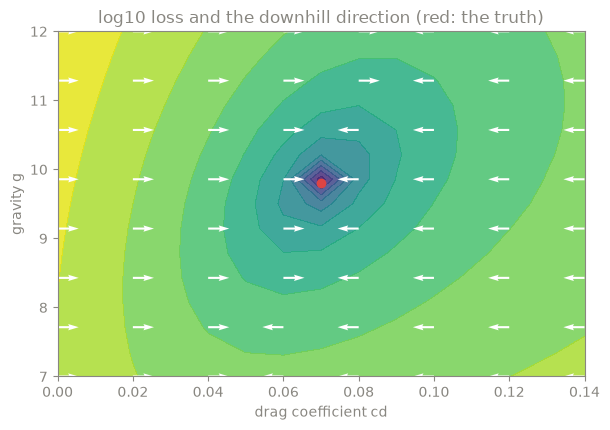
Fit the drag cd and gravity g from the final velocities of 256 balls (truth: cd = 0.07, g = 9.81). vmap
over a grid of Param pairs gives the loss and its gradient at every point; hessian gives the curvature at the minimum.
vs = 5.0 * jax.random.normal(jax.random.key(3), (3, 256))


def final(cd, g):
    v = vs
    for _ in range(20):
        v = step(v, cd, 0.05, g)
    return v


truth = final(0.07, 9.81)
loss = lambda cd, g: ((final(cd, g) - truth) ** 2).mean()

CD, GG = jnp.meshgrid(jnp.linspace(0.0, 0.14, 15), jnp.linspace(7.0, 12.0, 15))
value, (d_cd, d_g) = jax.vmap(jax.vmap(jax.value_and_grad(loss, argnums=(0, 1))))(CD, GG)
((h_cc, h_cg), (_, h_gg)) = jax.hessian(loss, argnums=(0, 1))(0.07, 9.81)
H = jnp.array([[h_cc, h_cg], [h_cg, h_gg]])
print("curvature at the minimum (eigenvalues):", jnp.round(jnp.linalg.eigvalsh(H), 2))
curvature at the minimum (eigenvalues): [2.80000e-01 1.05003e+03]
Contours of the loss with arrows pointing downhill (-grad, drawn at equal length). The valley is steep across cd and nearly flat along g, which is what the two curvatures above say: the data pins the drag down far better than gravity.
import matplotlib.pyplot as plt
import numpy as np

fig, ax = plt.subplots(figsize=(6.2, 4.4))
ax.contourf(CD, GG, np.log10(value + 1e-12), levels=14, cmap="viridis", alpha=0.85)
span = np.array([0.14, 5.0])  # axis ranges, so arrows have equal length on the page
down = -np.stack([d_cd, d_g]) / span[:, None, None]
down = down / (np.linalg.norm(down, axis=0) + 1e-12) * 0.04
every = (slice(None, None, 2), slice(None, None, 2))
ax.quiver(CD[every], GG[every], down[0][every] * span[0], down[1][every] * span[1],
          angles="xy", scale_units="xy", scale=1, color="white", width=0.004)
ax.plot(0.07, 9.81, "o", color="#d44")
ax.set(xlabel="drag coefficient cd", ylabel="gravity g", title="log10 loss and the downhill direction (red: the truth)")
plt.tight_layout()
What just happened#
Planes batch for free (one launch); Param batches loop (one launch per entry): the table above reads it off the program.
jacfwdandjacrevuse the forward and reverse kernels hawk derived;hessianuses both.You never wrote a derivative.
Next#
A stepping loop in
lax.scan: balls that land and stop.eagle inside your JAX program: what crosses, what is refused, the limits.