

Write a manifest#
Build the small JSON document that describes a compiled kernel, and watch raptor refuse every way of getting it wrong.
Time: ~5 min · Runs on: CPU, no GPU needed · You need: What the contracts buy you
The code#
raptor.schema.validate_manifest checks the manifest dict’s shape — never
whether the artifact it names actually exists or runs. The cells below walk
through what counts as a valid shape, one rule at a time, starting with the
simplest manifest that passes:
from raptor.schema import validate_manifest

v1 = {
    "schema_version": 1,
    # pattern: which kind of kernel this is; "pure" = no side effects
    "pattern": "pure",
    "aether_abi": "aether-abi/1",
    # format "ptx": NVIDIA's GPU assembly format
    "plugins": [{"name": "two_body_step", "format": "ptx"}],
}
validate_manifest(v1)
print("v1 OK")
v1 OK
No exception, and nothing printed but the OK — a v1 manifest carries none of schema v2’s execution-axis keys.
Schema v2 adds the execution axis — exec_targets/exec_access — as two more top-level keys, still validated the same way:
v2 = {
    "schema_version": 2,
    "pattern": "pure",
    "aether_abi": "aether-abi/2",
    "exec_targets": ["host", "device"],
    # sample_local: touches only this one sample's own data
    "exec_access": "sample_local",
    "plugins": [{"name": "two_body_step", "format": "ptx"}],
}
validate_manifest(v2)
print("v2 OK")
v2 OK
Both versions load today: v2 is additive, never a replacement for v1.
Three ways to get it wrong, and the exact refusal each one gets. First: a v1 document may not carry a v2 execution key.
bad_v1 = dict(v1, exec_targets=["host"])
try:
    validate_manifest(bad_v1)
except ValueError as exc:
    print("rejected (v1 + exec key):", exc)
rejected (v1 + exec key): '<document>': schema v1 must not carry execution key(s) ['exec_targets'] (the execution axis is schema-v2-only; set schema_version=2 and aether_abi='aether-abi/2' to use it)
The version tag alone decides which keys are legal — exec_targets on a v1 document is a breach, not an upgrade hint.
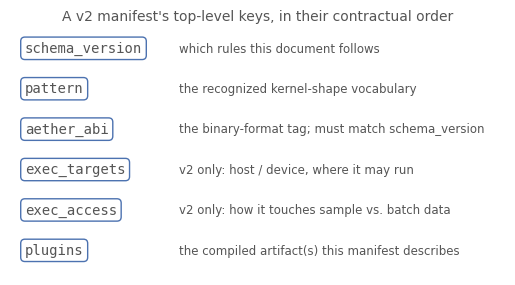
Second: the top-level keys are contractual in order — plugins may not come before the execution axis:
reordered = {
    "schema_version": 2, "pattern": "pure", "aether_abi": "aether-abi/2",
    "plugins": v2["plugins"], "exec_targets": v2["exec_targets"],
    "exec_access": v2["exec_access"],
}
try:
    validate_manifest(reordered)
except ValueError as exc:
    print("rejected (wrong key order):", exc)
rejected (wrong key order): manifest top-level key order violates the key-order contract: got ['schema_version', 'pattern', 'aether_abi', 'plugins', 'exec_targets', 'exec_access'], expected ['schema_version', 'pattern', 'aether_abi', 'exec_targets', 'exec_access', 'plugins']
Same keys, same values, wrong order — rejected, because the order itself is part of the contract.
Third: a schema version this loader (the code that reads and checks a manifest) does not understand is refused outright — forward-strict (refuses anything newer than it knows, rather than guessing what it means), never a silent best-effort parse:
too_new = dict(v1, schema_version=7)
try:
    validate_manifest(too_new)
except ValueError as exc:
    print("rejected (future version):", exc)
rejected (future version): '<document>' was built for plugin schema v7, but this loader supports v2; upgrade eagle to load it
A future version is a hard refusal, not a guess at what it might mean.
What just happened#
A manifest is validated for shape — key order, version, and the execution axis’s vocabulary — not for whether the artifact it names actually exists or runs.
Getting any one of those three things wrong raises a
ValueErrorthat names exactly what was wrong, rather than silently loading a best-effort guess.schema_version1 and 2 both load today — v2 only adds flat keys for where and how a kernel body may run; it never replaces v1.
In practice you will not hand-write this dict: hawk’s own writer,
hawk.artifact.write_manifest, emits one in the correct order from a
compiled kernel directly (see hawk’s
Your first kernel).
Try this#
Drop the aether_abi key from v2 entirely and validate it again — absence
is fine (the field is optional); only a wrong tag for the declared version
is refused.
Next#
Implement a protocol covers the other half of the contract: the shapes an engine or kernel provider must have. Deeper: Interoperability.