

Read the interop matrix#
See which array libraries RAPTOR officially supports, straight from the code — no table to trust blind.
Time: ~5 min · Runs on: CPU, no GPU needed, raptor alone (no cupy/torch/warp required) · You need: Implement a protocol
The code#
raptor.conformance.interop declares two things, as plain tuples: which
frameworks are CERTIFIED today, and which are ROADMAP — declared, not
yet built:
from raptor.conformance import interop

print("certified:", interop.CERTIFIED)
print("roadmap  :", interop.ROADMAP)
certified: ('numpy', 'cupy', 'torch', 'warp')
roadmap  : ('jax', 'tensorflow')
Four certified frameworks today, two more on the roadmap — reading this costs nothing, with none of them installed.
Check which of the certified ones this environment actually has, the plain way — no test framework needed, just whether each one imports:
import importlib.util

for fw in interop.CERTIFIED:
    found = importlib.util.find_spec(fw) is not None
    print(f"{fw:<10} {'found' if found else 'missing'}")
numpy      found
cupy       found
torch      found
warp       found
raptor itself needs none of these — this cell just reports what else happens to be installed here.
The same idea for ROADMAP: jax and tensorflow are declared absent
today. roadmap_framework checks both directions — declared-absent AND
actually-absent must agree, or it is a failure, not a quiet pass:
for fw in interop.ROADMAP:
    try:
        interop.roadmap_framework(fw)
        print(f"{fw}: absent, as declared")
    except AssertionError as exc:
        print(f"{fw}: unexpectedly installed in this environment -- {exc}")
jax: unexpectedly installed in this environment -- declared ROADMAP (absent-by-declaration) but INSTALLED — certify it or remove it from the env
tensorflow: absent, as declared
This page’s own build machine happens to have jax installed for unrelated reasons — the line above says so honestly instead of hiding it; that is the check working, not the family’s claim breaking.
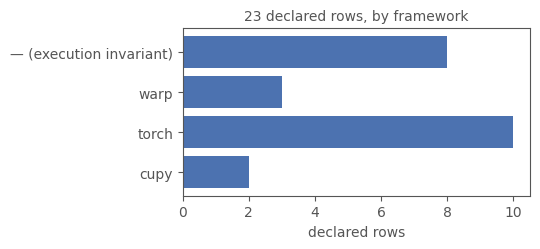
Finally, look up one row directly in ROWS — the full declaration every
claim on the matrix page cites:
decl = interop.ROWS["T-IN-CUDA-ALIAS"]
print(f"T-IN-CUDA-ALIAS -> framework={decl.framework} owner={decl.owner_repo} kind={decl.kind}")
T-IN-CUDA-ALIAS -> framework=torch owner=eagle kind=ALIAS
.framework/.owner_repo/.kind are the three fields every declared row
carries. kind is how data crosses between the two sides — ALIAS
(seen above) means the same memory, no copy; the matrix page defines the
other four kinds (COPY, STREAM, ENV, INVARIANCE) in full.
What just happened#
Reading
CERTIFIED/ROADMAP/ROWScosts nothing: no certified framework needs to be installed just to read the declaration.Checking whether a framework is actually present only needs
importlib.util.find_spec— the same plain checkinteropuses internally, no extra install required.ROWSnames, for every crossing the family certifies, which repository’s test suite proves it and how data crosses (ALIAS,COPY,STREAM,ENVorINVARIANCE).
Try this#
Look up a row you have not seen yet, e.g.
interop.ROWS["T-DEVICE-FAILLOUD"], and read its .framework/.owner_repo/
.kind straight from the object instead of this page.
Next#
Interoperability is the full, human-readable matrix — every row, what it certifies, and the ALIAS/COPY transfer laws every crossing on this page obeys. Want to add a crossing of your own? See Contributing a certification row for the two-repository process and the hygiene scanners its gate runs.