

What the contracts buy you#
You will see two unrelated classes pass the same raptor check, just by having the right methods.
Time: ~5 min · Runs on: CPU, no GPU needed · You need: nothing beyond raptor itself.
The code#
A typing.Protocol is a list of required methods: Python checks an object
against it with isinstance, by shape alone, never by whether it inherits
from anything. Below, two engines (an engine = the object that
actually runs a kernel) each implement the same shape; the methods beyond
what gets called exist only to complete that shape, so their return
values do not matter here:
First engine. ToyHostEngine implements KernelLauncher + Backend
(both explained below) by shape alone — no inheritance, no shared base
class:
class ToyHostEngine:
    name = "host"
    def launch(self, *a, **kw): return "ran on CPU threads"
    def assemble_args(self, *a, **kw): return ()
    def pure_origin(self, *a, **kw): return "numpy"
    def pure_prepare(self, *a, **kw): return ()
    def capabilities(self): return frozenset({"forward"})
    def compile(self, program): return program

print(ToyHostEngine().launch())
ran on CPU threads
Just a plain class — nothing about it mentions raptor yet.
A second, independent engine with the same shape. ToyDeviceEngine never
imports ToyHostEngine, and neither one imports raptor’s own runtime:
class ToyDeviceEngine:
    name = "device"
    def launch(self, *a, **kw): return "ran on the GPU"
    def assemble_args(self, *a, **kw): return ()
    def pure_origin(self, *a, **kw): return "cupy"
    def pure_prepare(self, *a, **kw): return ()
    def capabilities(self): return frozenset({"forward"})
    def compile(self, program): return program

print(ToyDeviceEngine().launch())
ran on the GPU
Also just a plain class — the two have not heard of each other.
Now check both against KernelLauncher (the four methods a launcher
needs) and Backend (the two more a backend needs) with isinstance —
the same runtime check a real caller such as eagle would make. The other
five methods on each class above exist only to complete that shape, so
their return values never mattered:
from raptor.protocols import Backend, KernelLauncher

for engine in (ToyHostEngine(), ToyDeviceEngine()):
    ok = isinstance(engine, KernelLauncher) and isinstance(engine, Backend)
    print(f"{engine.name:>6}: KernelLauncher+Backend={ok}")
  host: KernelLauncher+Backend=True
device: KernelLauncher+Backend=True
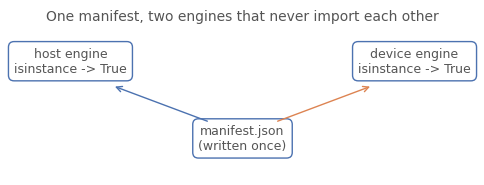
Both report True — the protocol checked their shape, never their ancestry.
What just happened#
KernelLauncherandBackendaretyping.Protocols: an object satisfies them by having the right methods, checked at runtime withisinstance, never by inheriting from a shared base class.The two toy engines above never import each other, yet both pass the exact same checks a real engine such as eagle would.
A compiled kernel ships with a small manifest describing it — covered next — but running one needs an engine shaped like these first.
Try this#
Rename launch to run on ToyDeviceEngine and re-run the loop:
isinstance(..., KernelLauncher) drops to False — the protocol checks
names, not intentions.
Next#
Write a manifest covers the document a compiler such as hawk writes once, and that an engine like these would read. Deeper: Concepts.