

Implement a protocol#
Give an object the right methods and it satisfies raptor’s contracts — whether or not it has ever heard of raptor.
Time: ~5 min · Runs on: CPU, no GPU needed · You need: What the contracts buy you
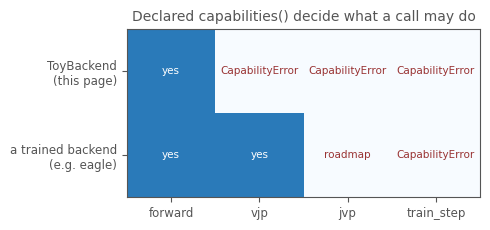
The code#
An Executable is a compiled, callable program: it declares forward,
vjp (reverse-mode: given a cotangent — a weighting of the output —
produces the matching weighting of the input), jvp (forward-mode:
given a tangent — a direction in the input — produces the matching
direction in the output), and parameters. Below, ToyExecutable
implements that shape by hand:
from raptor.protocols import CapabilityError, Executable

class ToyExecutable:
    def __init__(self, fn): self._fn = fn
    def forward(self, inputs): return self._fn(inputs)
    def vjp(self, cotangents): raise CapabilityError("no vjp")
    def jvp(self, tangents): raise CapabilityError("no jvp")
    def parameters(self): return []

print("Executable?", isinstance(ToyExecutable(lambda x: x), Executable))
Executable? True
What vjp/jvp actually compute does not matter below — only that calling
one ToyBackend has not declared will raise CapabilityError (a dedicated
exception, explained below), not guess.
A Backend builds one of those: capabilities() is its own declaration of
what it supports:
from raptor.protocols import Backend

class ToyBackend:
    name = "toy"
    def capabilities(self): return frozenset({"forward"})
    def compile(self, program): return ToyExecutable(program)

print("Backend?", isinstance(ToyBackend(), Backend))
Backend? True
Both checks pass by shape alone — “duck typing”: judged by which methods exist, never by which class an object inherits from.
Now use them together: compile a program, call the one capability
ToyBackend declared, then call the one it did not — which raises
CapabilityError (a dedicated exception: this object cannot do that,
by declaration) rather than returning a silent wrong answer:
backend = ToyBackend()
executable = backend.compile(lambda x: x * 2)
print("forward(21) =", executable.forward(21))
try:
    executable.vjp(None)
except CapabilityError as exc:
    print("caught:", exc)
forward(21) = 42
caught: no vjp
forward runs; the undeclared vjp raises instead of returning a silent wrong answer.
The kernel-provider protocol#
ManifestProvider is satisfied by anything with a matching
build(directory) method — it duck-types hawk’s own Bundle, the object
that writes a kernel’s manifest, without either side importing the other:
from raptor.protocols import ManifestProvider

class ToyBundle:
    def build(self, directory):
        """Pretend to emit a manifest; return its path."""
        return f"{directory}/manifest.json"

print("ManifestProvider?", isinstance(ToyBundle(), ManifestProvider))
print("A plain object is not:", isinstance(object(), ManifestProvider))
ManifestProvider? True
A plain object is not: False
A plain object() fails the check; ToyBundle passes it on the strength of its one method alone.
What just happened#
capabilities()is a declaration a backend makes about itself; calling a capability it never declared raisesCapabilityErrorrather than returning a silent wrong answer.ManifestProvideris satisfied the same structural way asBackend/Executable— by shape, checked withisinstance, never by inheritance.None of the toy objects above import hawk or eagle, yet each one is exactly what a real engine checks for before it will run a kernel.
Try this#
Add "vjp" to ToyBackend.capabilities() without adding a real vjp method
to ToyExecutable — isinstance(executable, Executable) still reports
True (the protocol only checks that the method exists, not that the
declared capability set agrees with it); the mismatch only shows up when you
actually call it.
Next#
Read the interop matrix reads the family’s own certification declaration. Deeper: Concepts.
Going deeper (optional)#
Marshal mirrors eagle’s own per-role input coercion — the shape a
launcher (the code that actually calls a compiled kernel) needs once it
must bind real arguments: state vectors, per-sample scalars, uniform
constants, lookup tables. ToyMarshal below is the minimal object
satisfying all seven methods, each returning an empty/default value:
from raptor.protocols import Marshal

class ToyMarshal:
    def coerce_vec_inputs(self, *a, **kw): return ({}, 1)
    def coerce_mat_inputs(self, *a, **kw): return {}
    def coerce_per_sample(self, *a, **kw): return {}
    def coerce_uniforms(self, *a, **kw): return {}
    def coerce_tables(self, *a, **kw): return {}
    def coerce_terminated(self, *a, **kw): return None
    def require_n(self, n, **kw): return n

print("Marshal?", isinstance(ToyMarshal(), Marshal))
Marshal? True
True — none of the seven methods above do real work, but all seven exist, and that is all the protocol asks.