

Adding a function to aether#
Add your own maths function that runs on CPU and GPU, without editing aether.
Time: ~6 min · Runs on: CPU · You need: Device math
running on: cpu
Every aether::math entry point is built from one macro,
AETHER_MATH_UNARY. Here is the whole of erf/erfc, two lines
total:
AETHER_MATH_UNARY(erf, erff, ::erf, std::erf(x))
AETHER_MATH_UNARY(erfc, erfcf, ::erfc, std::erfc(x))
NAME is the function name; FLOATFN/DOUBLEFN are the device-pass
callables (what runs when this file is built as CUDA); STDEXPR is the
host-pass expression (what runs otherwise).
The cell below adds cot (cotangent, 1/tan) the same way.
AETHER_FORCEINLINE() asks the compiler to always inline the tiny
wrapper rather than emit a real call – one overload for float, one
for double, matching the macro’s own two legs:
aether/math/detail/MathDispatch.h is the macro’s own home – the
exact header aether’s own special.h includes to build erf/erfc –
and MathDispatchUndef.h closes its scope right after, the same way
every real facade header in aether/math/ does.
The two helpers below are plain free functions, named cotFloat/
cotDouble in aether’s own camelCase convention for a helper like
this:
COT_SCAFFOLD = r"""
    #include "aether/math/detail/MathDispatch.h"

    AETHER_DEVICEHOST() AETHER_FORCEINLINE() float cotFloat(float x) { return 1.0f / ::tanf(x); }
    AETHER_DEVICEHOST() AETHER_FORCEINLINE() double cotDouble(double x) { return 1.0 / ::tan(x); }

    namespace my_contrib {
    AETHER_MATH_UNARY(cot, cotFloat, cotDouble, 1.0 / std::tan(x))
    }

    #include "aether/math/detail/MathDispatchUndef.h"
"""
print("COT_SCAFFOLD defined -- one new free function, ready to call.")
COT_SCAFFOLD defined -- one new free function, ready to call.
print(run_cpp(r"""
    std::printf("cot(1.0f) = %.6f   cot(1.0) = %.6f\n",
                 my_contrib::cot(1.0f), my_contrib::cot(1.0));
""", top=COT_SCAFFOLD, includes=("<cmath>",)))
cot(1.0f) = 0.642093 cot(1.0) = 0.642093
Both overloads agree with 1/tan(x) computed by hand – the macro is
templated on float/double, dispatching to whichever this call needs.
What you will build (the picture)#
A sweep of the new function, using the same scaffold defined above:
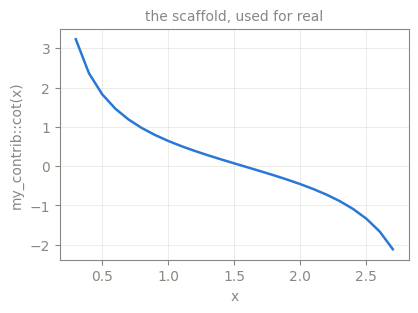
What just happened#
AETHER_MATH_UNARY(NAME, FLOATFN, DOUBLEFN, STDEXPR)is the whole scaffold aether’s ownerf/erfcuse.The demo above adds a genuinely new function (
cot) with zero edits to aether’s own headers – proof the mechanism is just a macro.aether/math/detail/MathDispatch.his adetail/header; the include/define/undef cycle around it is the same way every real facade header inaether/math/is written.
Try this#
Add a second trig identity, coth(x) = 1/tanh(x), using the same
cotFloat/cotDouble/AETHER_MATH_UNARY pattern.
Next#
This is the last tutorial in the aether path. hawk’s vocabulary tutorials pick up from here if you want to write kernels that call into aether; deeper: aether/math/detail/MathDispatch.h in the API reference for the macro’s full definition.
Going deeper (optional): landing it for real#
The banded (BandedReal) companion macros are a separate, certified
extension that widens five entry points (abs, copysign, fmax,
fmin, pow) to accept aether’s emulated-double type – out of scope
for a brand-new function like cot above.
This tutorial proves the mechanism, not a shipped function: cot
above lives only in this notebook’s temp file. Landing it for real –
so it ships as aether::math::cot for every consumer, with the banded
companion and the accuracy sweep its neighbours get – means the same
two lines inside aether/math/*.h itself, as a pull request.
A new aether::math function is only half the path to a hawk kernel
calling it: hawk needs to know the op exists, how to spell it in
generated code, and what its derivative is. hawk’s own contributor
guide, Add a native function end to
end,
picks up exactly where this tutorial stops – its own step 1 is the same
AETHER_MATH_UNARY line this tutorial just ran.