

Expressions without temporaries#
Chain
+,-and*on a vector in one line, and nothing in between ever gets materialized.
Time: ~7 min · Runs on: CPU · You need: One array, two machines
running on: cpu
aether::Vec3d is a single 3-component vector – one fixed value, not a
batch of samples like the Array from tutorial 1:
print(run_cpp(r"""
    using aether::Vec3d;
    Vec3d a, b, c;
    for (std::size_t i = 0; i < 3; ++i) {
        a(i) = static_cast<double>(i) + 1.0;        // a = (1, 2, 3)
        b(i) = static_cast<double>(i) * 2.0 - 3.0;  // b = (-3, -1, 1)
        c(i) = static_cast<double>(i) + 0.5;        // c = (0.5, 1.5, 2.5)
    }
    std::printf("a=(%g,%g,%g)\n", a(0), a(1), a(2));
"""))
a=(1,2,3)
Three fixed 3-vectors – no batch dimension, unlike tutorial 1’s Array.
a + b, 0.5 * a and a - b all compose into one aether::Expression
tree, evaluated only when the result is assigned. Three operators below,
one assignment:
print(run_cpp(r"""
    using aether::Vec3d;
    Vec3d a, b, c;
    for (std::size_t i = 0; i < 3; ++i) {
        a(i) = static_cast<double>(i) + 1.0;
        b(i) = static_cast<double>(i) * 2.0 - 3.0;
        c(i) = static_cast<double>(i) + 0.5;
    }
    Vec3d combo = (a + b) - 0.5 * c;   // three nodes deep, one assignment
    std::printf("(a+b) - 0.5*c = (%g, %g, %g)\n", combo(0), combo(1), combo(2));
"""))
(a+b) - 0.5*c = (-2.25, 0.25, 2.75)
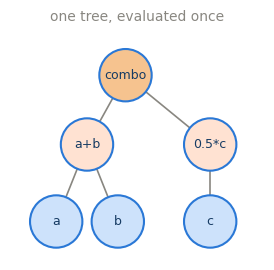
(a + b) - 0.5 * c builds a tree (-, with children + and *) and
evaluates it, element by element, only when combo is constructed.
The payoff: zero temporaries#
Write (a + b) - 0.5 * c by hand, one named step at a time, and the
compiler builds three separate Vec3d values. Write it as one
expression, and the expression stays a tree, not a Vec3d, until the
one assignment – checked at compile time, not timed:
print(run_cpp(r"""
    using aether::Vec3d;
    Vec3d a, b, c;
    for (std::size_t i = 0; i < 3; ++i) { a(i) = 1.0; b(i) = 2.0; c(i) = 3.0; }

    Vec3d tmp1 = a + b;          // Vec3d #1
    Vec3d tmp2 = 0.5 * c;        // Vec3d #2
    Vec3d named = tmp1 - tmp2;   // Vec3d #3
    std::printf("by hand: 3 named Vec3d values\n");
"""))
by hand: 3 named Vec3d values
Now write the identical computation as one expression, and check its type before it is ever assigned:
print(run_cpp(r"""
    using aether::Vec3d;
    Vec3d a, b, c;
    for (std::size_t i = 0; i < 3; ++i) { a(i) = 1.0; b(i) = 2.0; c(i) = 3.0; }

    auto expr = (a + b) - 0.5 * c;
    static_assert(!std::is_same_v<decltype(expr), Vec3d>,
                  "still a tree, not a Vec3d, right up to the line below");
    Vec3d fused = expr;          // assignment is where the tree becomes a Vec3d
    std::printf("expression stays a tree until assignment (checked at compile time)\n");
""", includes=("<type_traits>",)))
expression stays a tree until assignment (checked at compile time)
decltype(expr) is a Sum<...> node type, never Vec3d, right up until
fused is constructed – a static_assert the compiler itself checks,
not a number measured on one machine. The guarantee holds at every
optimization level, including none at all.
What you will build (the picture)#
A tree, not a value – combo = (a + b) - 0.5*c is three nodes,
evaluated once:
What just happened#
a + b,0.5 * aanda - ball build oneaether::Expressionnode tree; nothing is computed until that tree is assigned into a real destination.Written by hand, three named steps build three
Vec3dvalues; written as one expression, the result stays a tree – not aVec3d– until that one final assignment, checked at compile time, not measured.Dot products, cross products and matrix-vector products go through the same
aether::Expressionbase.
Try this#
Add a fourth operator, e.g. (a + b) - 0.5 * c + a, and re-run the
expression cell: the tree grows one more node, the call site stays one
assignment.
Next#
Device math – call the same aether::math::*
functions from host and device code. Deeper:
Expression templates for the full node
catalogue.