

Your own device function and kernel#
Write the arithmetic once as an
AETHER_DEVICEHOST()function; dispatch it yourself with a loop on the CPU, or launch it as a kernel on the GPU (optional, at the end).
Time: ~8 min · Runs on: CPU, GPU switch · You need: One array, two machines, Device math, Host vs device code
running on: cpu
AETHER_DEVICEHOST() marks an ordinary function so it compiles and
runs correctly whether it is called from plain CPU code or from inside a
GPU kernel. On the CPU, you dispatch it yourself, once per sample, with
an ordinary loop (OpenMP here):
print(run_cpp(r"""
    aether::Array<double, 1> v(6), out(6);
    auto vv = v.hostView();
    for (std::size_t i = 0; i < v.samples(); ++i)
        vv(0, i) = static_cast<double>(i) + 1.0;
    auto ov = out.hostView();
    #pragma omp parallel for
    for (std::size_t i = 0; i < v.samples(); ++i)
        ov(0, i) = speedPenalty(vv(0, i), 0.1);
    std::printf("speedPenalty(2, 0.1) = %g\n", ov(0, 1));
""", top="""
    AETHER_DEVICEHOST() double speedPenalty(double v, double drag)
    { return drag * v * v; }
"""))
speedPenalty(2, 0.1) = 0.4
speedPenalty is a plain function here; the #pragma omp parallel for
loop is what actually dispatches it, once per sample.
What you will build (the picture)#
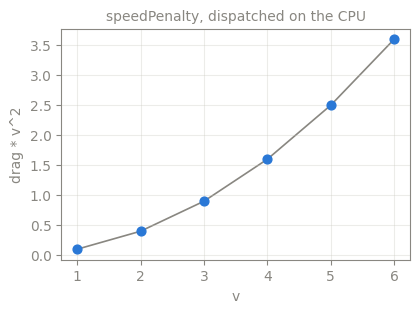
The per-sample result from the CPU run above:
What just happened#
AETHER_DEVICEHOST()marks a function as legal to call from host code and device code with the exact same source line.On CPU, you dispatch it yourself with a plain loop (OpenMP here).
Nothing about
speedPenalty’s own source names a device anywhere.
Try this#
Change 0.1 (the drag coefficient) in the cell above and re-run: the
printed value changes.
Next#
Adding a function to aether – the macro scaffold
behind aether::math’s own dispatch, and how a new one gets added.
Deeper: Host vs device code for the rest of
the device-side vocabulary.
Going deeper (optional): the same function as a GPU kernel#
A GPU version needs a kernel entry point, AETHER_KERNEL(), launched
over a 2-level grid of blocks and threads – speedPenalty’s own body
never changes. Inside the kernel, blockIdx, blockDim and threadIdx
are CUDA’s own built-ins for “which thread am I”: blockIdx.x * blockDim.x + threadIdx.x turns that 2-level grid into the flat sample
index i each thread uses to find its own sample.
kernel_top = r"""
    AETHER_DEVICEHOST() double speedPenalty(double v, double drag)
    { return drag * v * v; }

    using Vec1View = aether::Array<double, 1>::ViewT;

    AETHER_KERNEL()
    void speedPenaltyKernel(Vec1View v, Vec1View out, double drag, std::size_t n)
    {
        const std::size_t i = blockIdx.x * blockDim.x + threadIdx.x;
        if (i < n)
            out(0, i) = speedPenalty(v(0, i), drag);
    }
"""
print(kernel_top.strip())
AETHER_DEVICEHOST() double speedPenalty(double v, double drag)
    { return drag * v * v; }

    using Vec1View = aether::Array<double, 1>::ViewT;

    AETHER_KERNEL()
    void speedPenaltyKernel(Vec1View v, Vec1View out, double drag, std::size_t n)
    {
        const std::size_t i = blockIdx.x * blockDim.x + threadIdx.x;
        if (i < n)
            out(0, i) = speedPenalty(v(0, i), drag);
    }
On the host side, Array<T, Es...>::ViewT is the device-visible view
type; .upload() moves the data to the GPU, and .deviceView() hands
back a view pointing at it there:
aether::cuda::launchConfig(n) picks a block/thread count for n
samples, and <<<cfg.blocks, cfg.threads>>> is CUDA’s own launch
syntax. This page builds on CPU, so the cell below runs for real only
where a GPU is visible; otherwise it prints a one-line placeholder:
kernel_body = r"""
    aether::Array<double, 1> v(6), out(6);
    auto vv = v.hostView();
    for (std::size_t i = 0; i < v.samples(); ++i)
        vv(0, i) = static_cast<double>(i) + 1.0;
    v.upload();

    const auto cfg = aether::cuda::launchConfig(v.samples());
    speedPenaltyKernel<<<cfg.blocks, cfg.threads>>>(v.deviceView(), out.deviceView(), 0.1, v.samples());
    out.download();
    std::printf("speedPenalty(2, 0.1) = %g\n", out.hostView()(0, 1));
"""
print(run_or_show(kernel_body, top=kernel_top))
(shown, not run: no GPU visible)
Nothing about speedPenalty’s own source changes between the CPU loop
and this kernel – only the dispatch around it does.